

Why chargeBIG
Robust charging technology
With over 500,000 successfully completed charging processes, the system availability of the smallBOX is over 98%.
Easy installation and commissioning
The pre-configured sub-distribution enables quick commissioning and, thanks to minimal hardware usage at the charging points, simultaneously reduces installation and maintenance effort.
Innovative product approach
A centralized system architecture with intelligent load management ensures optimal utilization of available network capacities.
Customized service
At chargeBIG, the focus is on individual service and professional advice in order to best meet the requirements of our customers.

Smart electrification in practice
Public charging points
Perfectly suited for park and ride facilities and multi-story car parks with long-term parking.
Ideal for cities and municipalities
For municipalities and cities, the chargeBIG charging infrastructure is available at public locations with
larger parking areas, such as Park & Ride lots or parking garages, are of interest
Public billing
chargeBIG complies with calibration law and therefore charging current can be charged to third parties.
to be billed.
As a payment method, we offer the self-developed chargeBIG app and the payment terminal including charging card, as well as ad hoc payment via credit card and PayPal.

Flexible activation
Via eRoaming, chargeBIG charging infrastructure is listed in the common charging apps and can also be billed and activated via these apps.
At the parking lot
Compact wallbox
smallBOX

Charging capacity up to 22 kW
Fixed Type 2 charging cable
(5 m / 7.5 m)
Activation via chargeBIG app using QR code or NFC tag
Activation via common charging apps using eRoaming
Single or dual loader configuration
Dimensions:
Wall bracket in mm (H x W x D)
110 x 60 x 110
Dimensions in mm (H x W x D)
1150 x 100 x 100
In the supply room
chargeCLUSTER
Pre-configured sub-distribution

In accordance with calibration law
(Recalibration in the field possible)
Dynamic or static load management
Interfaces:
Modbus TCP, OCPP 1.6J
Communication via LTE & LAN
Integration into the building management system
Integration into fire alarm system
Integrated RCD & DC fault current sensor
All-In-One Solution
smallBOX PUBLIC
AC-Charger with Terminal

Charging capacity up to 22 kW
4 attached Type 2 charging cables
Integrated sub-distribution
Including load management
In accordance with calibration law
Communication via integrated LTE hotspot
Activation possible via charging card or credit card and charging apps
The mobile solution
smallBOX PORTABLE
Mobile, crane-liftable and portable

Charging capacity up to 22 kW
4 x Attached Type 2 charging cables, 7.5 m
Static load management
Interfaces:
Modbus TCP, OCPP 1.6J
In accordance with calibration law
Communication via LTE
Connection up to 63 A three-phase
Integrated RCD & DC fault current sensor
To activate
Terminal
For the smallBOX charging system

In accordance with calibration law
(Recalibration in the field possible)
Activation via chargeBIG app, charging and credit cards as well as apps of common charging providers
Interfaces:
Modbus TCP, OCPP 1.6J
Communication via LTE & LAN
Integration into the building management system
What's happening in the background?
No more expensive peak loads
Load management for charging infrastructure refers to the targeted control and optimization of charging station electricity consumption to prevent overloading the power grid. Intelligent systems monitor and adjust energy demand in real time, thereby optimizing charging times and reducing costs. This enables the sustainable use of existing resources and promotes the integration of renewable energies. Load management is therefore a crucial factor for the future of electromobility.


What happens at the charging point?
Activation within a few seconds
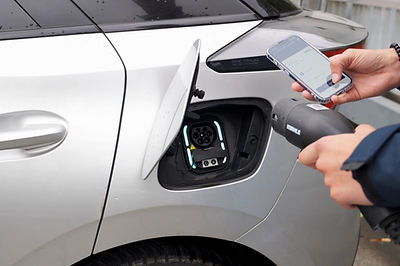
The smallBOX offers particularly easy operation and allows the charging process to be activated within a few seconds via app or NFC tag on the smartphone.
Depending on the operator, various charging tariffs are available, ensuring maximum flexibility. Payment is conveniently made via credit card (Visa, Mastercard, American Express), PayPal, or SEPA direct debit.
For employees entitled to company cars, it is also possible to directly assign the charging processes to the respective cost center, thus ensuring a transparent and efficient billing process.


Mounting options for every application


Performance promise


Financing models
Leasing – Focus on flexibility
No high initial investment
Predictable monthly payments
Preserving liquidity
More financial leeway
High flexibility over the term
Fast decision-making processes
Supported by our
Financing partner

Rent-to-own – Focus on ownership
-
Predictable monthly payments instead of a one-time investment
-
Transfer of ownership at the end of the term
-
Capitalization in fixed assets is possible
-
Tax depreciation usable
-
Long-term availability of the infrastructure
-
Ideal for funding programs and internal guidelines
Here's what our partners say

Managing Director, Sinergy
Svetoslav Sultani
As an electrician who has already installed the chargeBIG6 charging solution, I can confirm that the ease of use of this system is impressive. Compared to conventional wallboxes, chargeBIG6 offers a seamless and straightforward installation, saving time and money. My colleagues and I were surprised at how quickly and efficiently we were able to set up a reliable charging system. I recommend the chargeBIG charging solution to all customers and hesitant electricians as a cost-effective and simple solution for electrifying parking spaces.

Co-Founder & CEO, Pionix
Marco Möller
With the open-source project Everest, we want to remove the obstacles to electromobility: Differently developed
Implementations of relevant standards and
Incompatibilities due to software-
Standalone charging solutions. With
We found a partner in chargeBIG early on who, like us, is convinced of the advantages of a standardized and comprehensive charging infrastructure solution. This, coupled with extensive expertise, enthusiasm, and a passion for innovation, characterizes our collaboration with chargeBIG.
.jpg)
Innovation Manager, BlueRange
Jonas Kaufmann
By integrating chargeBIG into the BlueRange IoT platform, we are creating a new dimension in building automation and sustainability. The seamless connection between charging technology and intelligent building components allows us to raise energy efficiency and user comfort to a new level. Our partnership with chargeBIG is another step towards future-proof buildings, which are already distinguished by SmartScore-certified use cases. Together, we are shaping the smart and sustainable building world of tomorrow.


